- Pain. Warehouse and cluster sizing forces a standing tradeoff between paying for idle capacity and risking a slowdown at the worst moment, and teams set it once and never revisit it, because right-sizing is a setting nobody owns.
- Who it is for. Data platform leads and engineering managers owning the warehouse or cluster bill and its SLAs.
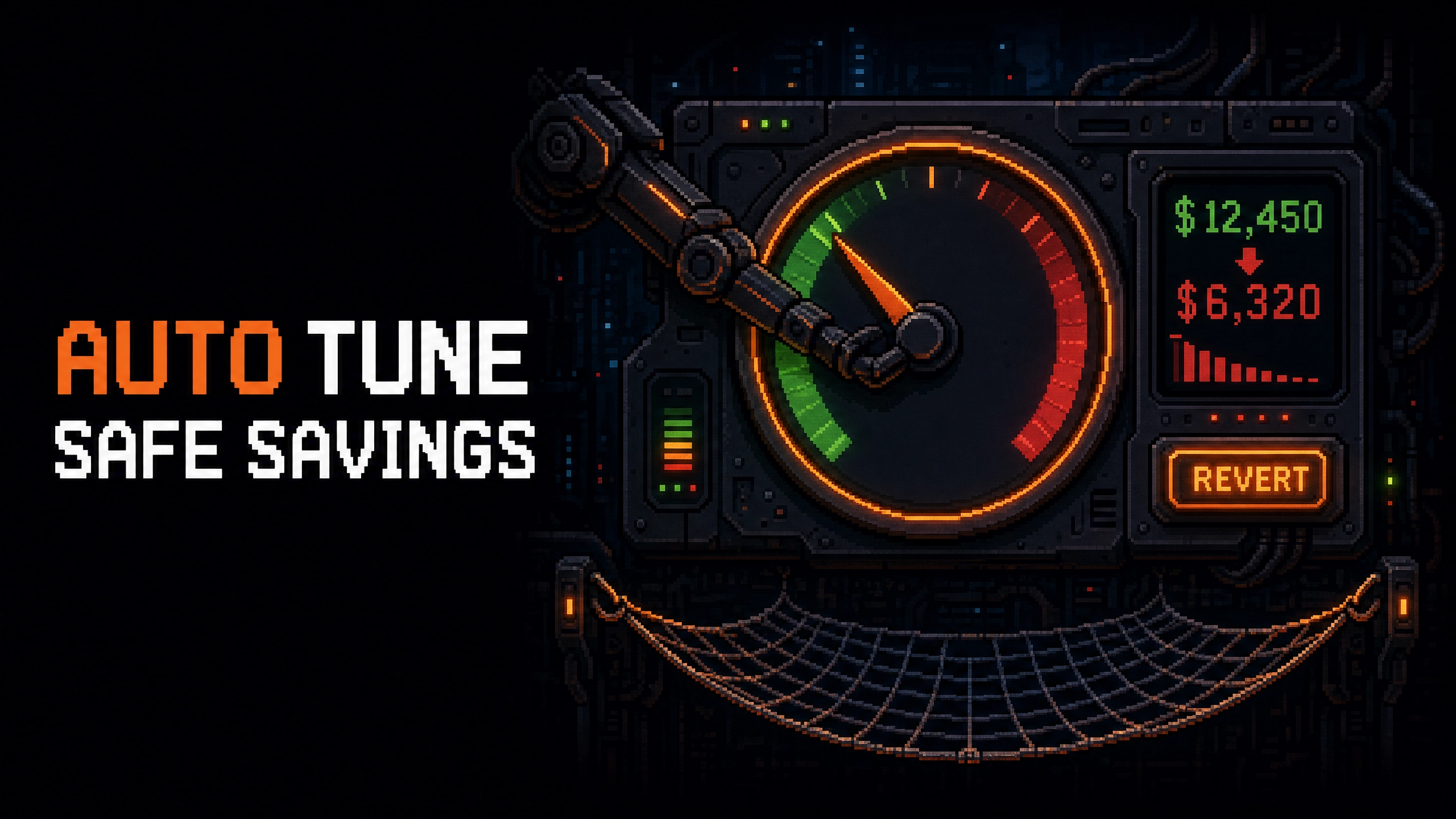
- What it is. Altimate Auto Tune resizes a Snowflake warehouse or Databricks job automatically and reverts the change if it regresses against a rolling baseline.
"Fear Of The Regression" Is What Keeps Automated Tuning Switched Off
A retail-analytics platform lead inherits a Databricks workload that has cost more every quarter for two years. The right-size answer is obvious: half the jobs over-provision their clusters by a tier or two, a few under-provision and time out. The fix would be a cluster-config change per job. The lead does not make the change because the consequence of the wrong change on a critical job the night before a board report is worse than the consequence of overspending. Automated tuning solves the tax in theory; the lead does not enable it because the trust does not exist.
The trust problem is solvable. The answer is a tuning system that knows what "regression" means, reverts when it sees one, and shows the engineer what happened. That is the contract Altimate Auto Tune ships against.
The Contract Is The 1.5X Baseline Regression Rule
The Auto Tune self-revert is a hard rule:
| Step | What runs |
|---|---|
| 1 | Every job with an Auto Tune applied in the last 7 days is evaluated on its most recent run. |
| 2 | The run's duration is compared against the mean of the 7 preceding successful runs (the baseline). |
| 3 | If the run is 1.5x slower, failed, timed out, or was canceled → trigger revert. |
| 4 | Auto Tune reverts the cluster to its previous shape. |
| 5 | Auto Tune disables itself on that job to stop re-applying the bad tune. |
| 6 | A Slack alert notifies the team. |
| 7 | The audit log records the four-state flow: proposed → enabled → applied → rolled back. |
The rule is the kind of mechanical contract a security partner or a platform lead can audit. There is no "the algorithm decided"; there is a measurable threshold (1.5x), a measurable baseline (seven preceding successful runs), and a measurable response (revert + disable + alert). No engineer has to watch the dashboard; the contract watches.
Four States The UI Shows, Wired To The Audit Log
The Databricks Auto Tune tab on any job's detail page shows:
| Element | What the engineer sees |
|---|---|
| Current recommendation | the proposed cluster shape Auto Tune is suggesting |
| State card | proposed → enabled → applied → rolled back |
| Run-trend chart | cost alongside duration and success rate, on the same chart |
| Drawer banner | explicit revert rule: "Recommendations will be rolled back if a job's execution time exceeds 1.5x its baseline" |
| Toggle | enable or disable Auto Tune; a misconfigured workspace surfaces an actionable error instead of an invisible switch |
The state card is wired to the apply worker's audit log, so the UI reflects what actually happened on the cluster, not what was supposed to happen. The drawer stays open after a toggle flip so the new state is visible without losing place in settings; a toast confirms whether you enabled or disabled the tune.
The four states are the system's commitment; the audit log is the record of whether the system kept it.
Snowflake Auto-Suspend Savings As A Range, Not A Point
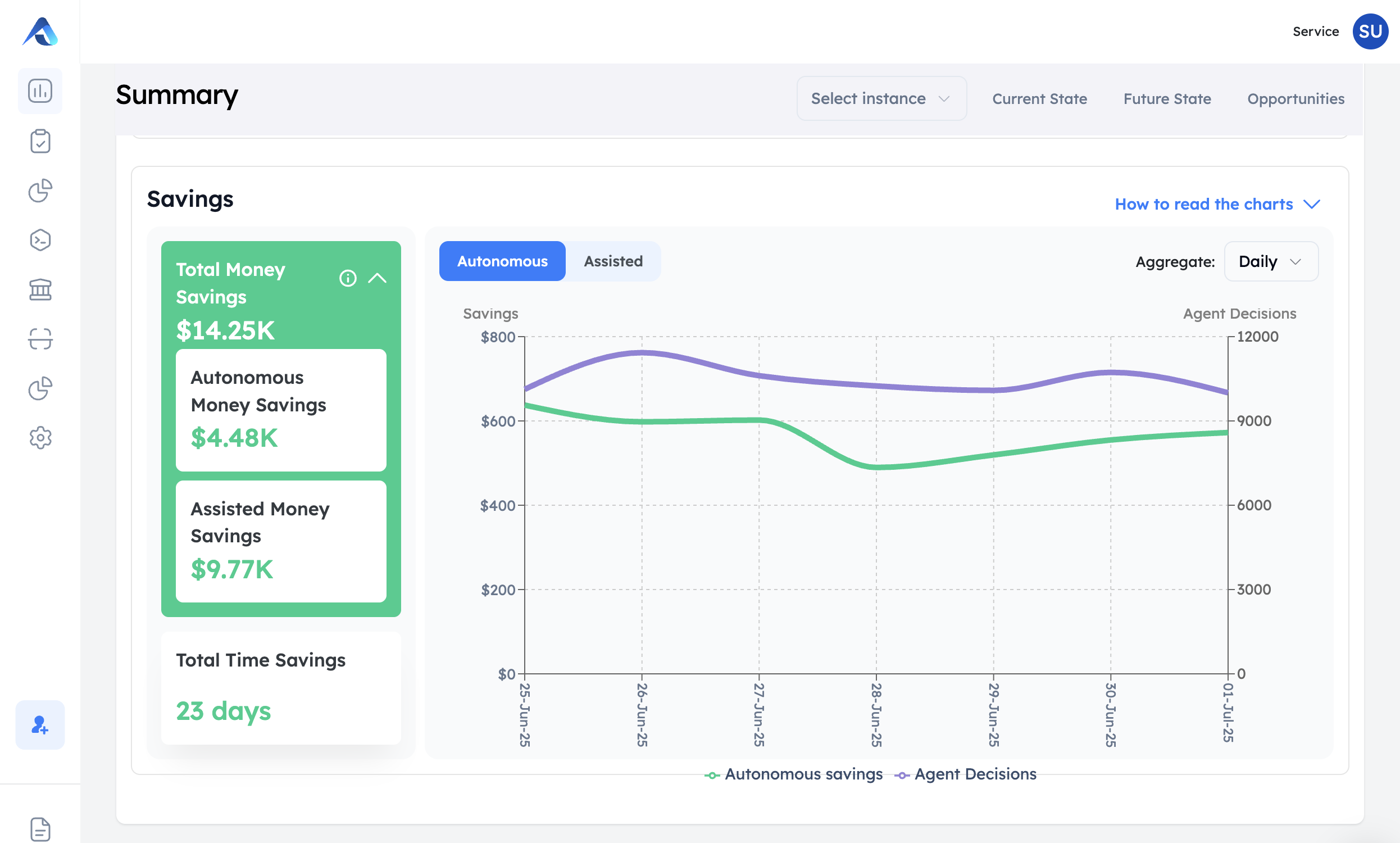
Altimate reports Snowflake auto-suspend savings as a range. Snowflake polls for suspendable warehouses roughly every 30 seconds, so the actual suspend happens between 0 and 30 seconds after the auto_suspend timer fires. A point estimate would assume immediate suspend; the engineer would carry that number to finance and miss by 15 seconds of runtime per cycle.
| Number | What it means |
|---|---|
| Best case | immediate suspend (timer fires, suspend happens) |
| Expected case | mid-poll, +15s of runtime per cycle |
The platform shows both. The finance number the platform lead carries to the review is the expected case, which matches reality. The optimism is gone; the savings claim survives the review. The number that ships is the number that holds up.
The Four-State Flow On A Worked Databricks Job
The realistic shape of an Auto Tune apply over a week:
| Day | State | What the engineer sees |
|---|---|---|
| Mon | Proposed | "Cluster etl_nightly could move from r5.4xlarge to r5.2xlarge. Estimated savings: ~$140/run." |
| Mon | Enabled | the engineer flips the toggle; the drawer confirms; the audit log records |
| Tue | Applied | the next run on r5.2xlarge; the run-trend chart shows cost down, duration up by 6% (within baseline) |
| Wed | Applied | second run on the new shape; duration steady, cost down |
| Sun | Applied (steady state) | seven runs on the new shape; the seven-run baseline now reflects the new normal |
| Next Mon | (a one-off run regresses 2.1x because of an upstream Spark stage stall) | Auto Tune reverts to r5.4xlarge, disables itself, sends Slack alert |
The team reviews the Slack alert, decides whether to re-tune or keep the previous shape. The companion articles on scheduled warehouse capacity and Studio cost analysis cover the wider cost-optimisation surface; this article covers the load-bearing piece, the auto-revert contract that makes automated tuning trustable.
A Tuning System The Team Can Actually Leave On
These three pieces together build a tuning surface the team can leave running. The 1.5x-baseline revert is the hard contract. The four-state UI is the visibility. The honest range on Snowflake savings is the honest math. The companion scheduled warehouse capacity article covers the calendar-driven capacity changes that pair with Auto Tune; the Studio cost analysis article covers the investigation surface that explains why a savings number changed. The cross-warehouse cost agent article covers the IDE-side companion that runs ad-hoc analysis on the same data. Auto Tune stops being the feature teams keep switched off because the contract makes the regression case safe.