The Altimate Agentic Data Engineering Platform


Context Graph
Altimate is a powerful agentic data engineering platform for modern data teams built on a combination of domain-specific tools trained on years of Fortune 500 query patterns that delivers 85% accuracy on cost optimization and 30 to 50% documented savings on real customer workloads.
Decision memory
Auto-extracts ADRs from every merged PR so agents can avoid expensive mistakes.
Technical metadata & cost intel
Cost profiles, cross-platform lineage, incident history.
Business metadata
Ownership, PII / SOX / GDPR classification, retention policies.
Governance
Governance gives agents the same instinct a good engineer has: know what this will cost, know what it will break, know when to ask.
Guardrails
Pre-execution cost checks, blast radius analysis across downstream models, dashboards, PII columns, and incident history.
Validation & reasoning traces
Every agent action leaves a paper trail with cost estimate, blast radius, confidence score, and the actual rationale for the decision.
Agent observatory
Track agents working in real time. What each one knows, what it tried, what it escalated, and why.
MCP, Tools & Skills
Altimate provides a unified suite of domain-specific skills and tools, eliminating the need for multiple servers and credentials, enabling data agents to work effectively across the data stack.
Local and remote, in the same config
Agents reach the tools they need whether the server runs locally on an engineer's laptop or as a hosted endpoint behind OAuth.
Vendor MCPs without the vendor sprawl
Use a vendor's MCP, or a hosted version we manage instead. The agent sees one unified tool surface, not a dozen disconnected ones.
Altimate MCP is the engine underneath
Altimate MCP validates every connection, stores credentials in one place instead of scattered config files, and gives your team a clean interface for managing connections.
Knowledge Hub context built in
The agent gets context from Confluence, Google Docs, and Notion through the same connection layer that handles the tools.
What's in the skills toolkit
SQL
Ten tools built on a real SQL parser including static analysis against 19 anti-patterns, translation across leading SQL databases and data warehouses. Optimization, formatting, diffing, fixing, explaining.
Column-level lineage
Trace columns end-to-end through joins and CTEs. Confidence drops for SELECT *, Jinja, or unqualified tables.
Schema, dbt, warehouse, FinOps
Live schema indexing, dbt manifest parsing and verified dbt builds. Warehouse connectivity and query history. FinOps surfaces query cost and right-sizing on real workloads.
Memory and custom
State that survives long sessions. Bring your own tools and the agent treats them with the same compile-and-validate guarantees as the built-ins.
Infrastructure
An agent needs an environment where it can spin up the runtime, run the transformation against real data, execute the tests, and verify the output before anything touches production. It has to work across the stack you actually run, not just one warehouse.
Sandboxes for the modern data stack
Provisioned, isolated environments with the runtimes your team already uses, ready in seconds. Pair them with zero-copy clones of your warehouse and the agent runs against your real data, at production scale, without duplicating a byte.
Bring your own LLM, or use ours
Use what your security team already approved, or use the Altimate LLM Gateway to route across Sonnet 4.6, Opus 4.6, GPT-5.4, and more, picking the right model for the task.
Your Entire Data Stack, in One Conversation.
Studio is a specialized, multi-agent AI solution to interact with entire data stacks using natural language, providing rich analysis across platforms and technologies.
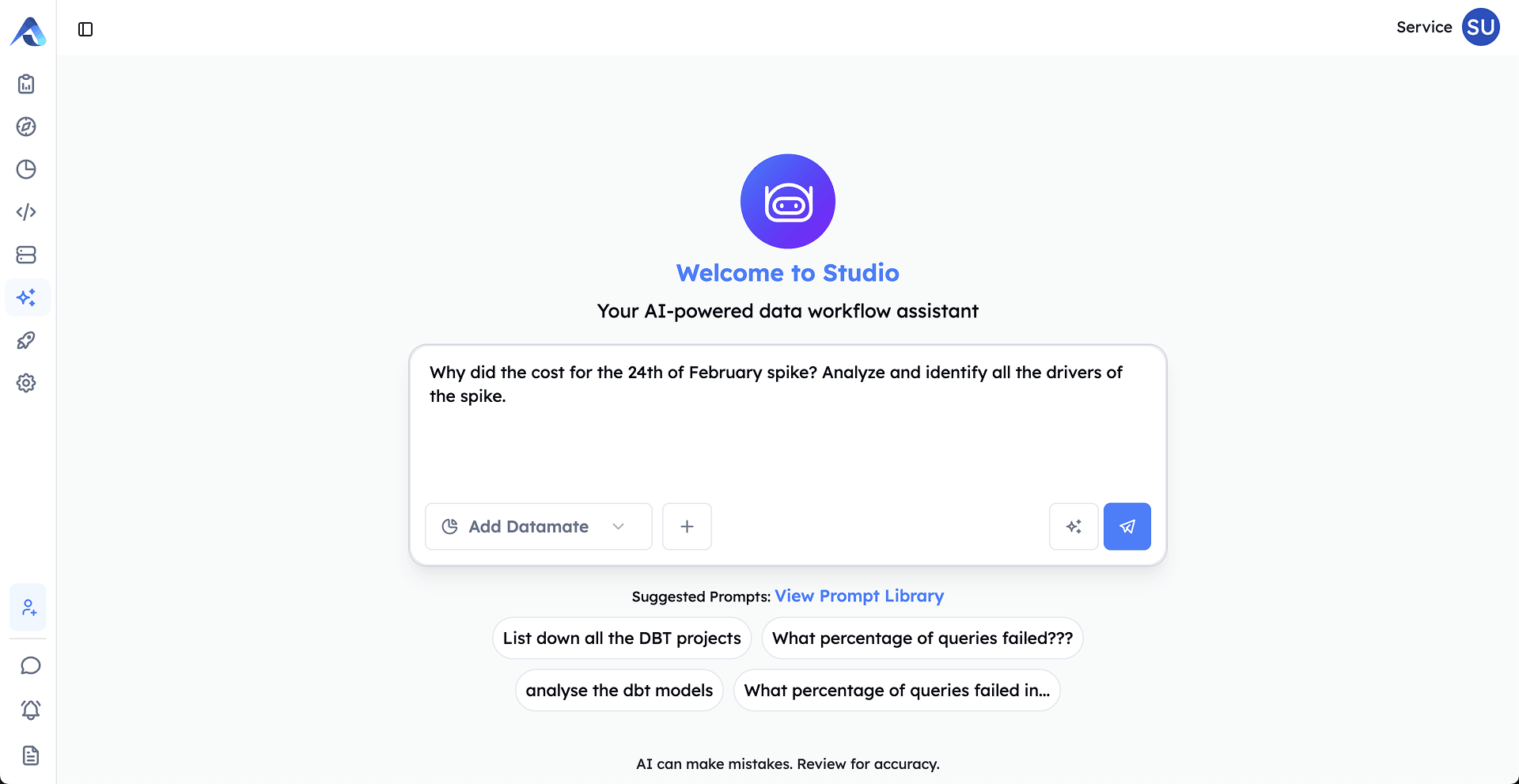
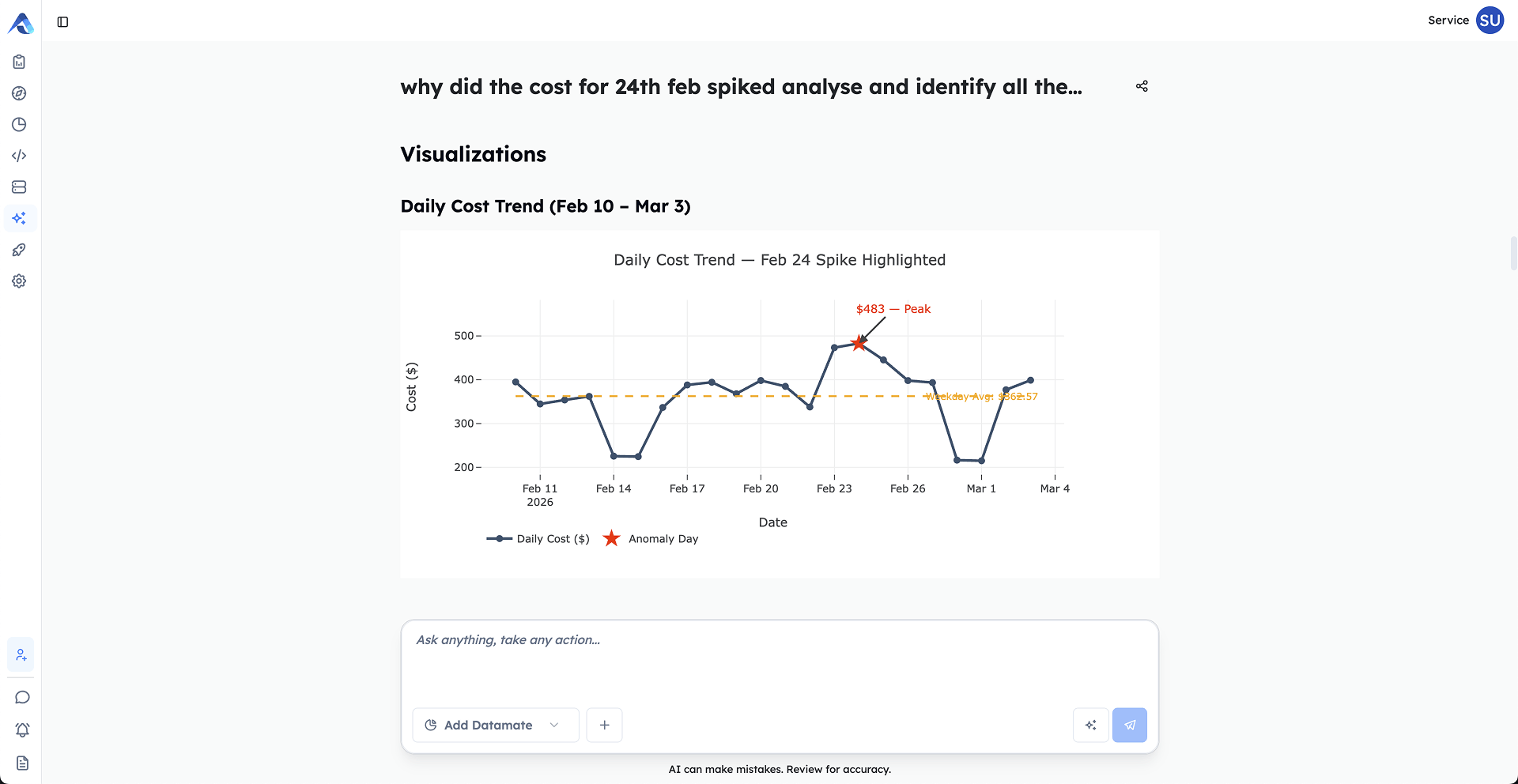
Cross-stack analysis
Lineage exploration, docs search, root cause analysis, optimization recommendations, and more — all from a single query.
Enriched context
Enrich queries with additional context. A shared Prompt Library lets teams launch common analyses instantly.
Structured outputs
Results are delivered with executive summaries, key metrics, root cause findings, and actionable next steps.
Always in context
Studio is context-aware, and persistent chat history means you can seamlessly resume past investigations.
Works with Your Stack.
DATA PLATFORMS
 Snowflake
 Databricks
'/%3e%3cpath%20clip-path='url(%23b)'%20d='M119.229%2086.48L80.625%2047.874%2064%2043.425l-14.933%205.55L43.3%2064l4.637%2016.729%2040.938%2040.938%208.687-.386z'%20opacity='.07'/%3e%3cg%20fill='%23fff'%3e%3cpath%20d='M64%2040.804c-12.81%200-23.195%2010.385-23.195%2023.196%200%2012.81%2010.385%2023.195%2023.195%2023.195S87.194%2076.81%2087.194%2064c0-12.811-10.385-23.196-23.194-23.196m0%2040.795c-9.72%200-17.6-7.88-17.6-17.6S54.28%2046.4%2064%2046.4%2081.6%2054.28%2081.6%2064%2073.72%2081.6%2064%2081.6'/%3e%3cpath%20d='M52.99%2063.104v7.21a12.794%2012.794%200%200%200%204.38%204.475V63.104zM61.675%2057.026v19.411c.745.137%201.507.22%202.29.22.714%200%201.41-.075%202.093-.189V57.026zM70.766%2066.1v8.562a12.786%2012.786%200%200%200%204.382-4.7v-3.861zM80.691%2078.287l-2.403%202.405a1.088%201.088%200%200%200%200%201.537l9.115%209.112a1.088%201.088%200%200%200%201.537%200l2.403-2.402a1.092%201.092%200%200%200%200-1.536l-9.116-9.116a1.09%201.09%200%200%200-1.536%200'/%3e%3c/g%3e%3c/svg%3e) BigQuery
BigQuery Microsoft Fabric
ORCHESTRATION
 dbt
dbt Airflow
 Dagster
'%3e%3cpath%20d='M30%2022.7132L14.9936%2015.1261V30.5486L30%2022.7132Z'%20fill='url(%23paint0_linear_prefect)'/%3e%3cpath%20opacity='0.2'%20d='M16.9049%2029.5497L14.9936%2018.0846V30.5486L16.9049%2029.5497ZM28.0766%2021.7329L14.9936%2015.1261V16.8082L28.0766%2021.7329Z'%20fill='%230D3958'/%3e%3cpath%20d='M0.908189%2048.5507C0.939561%2048.532%2014.6927%2041.8043%2014.7048%2041.797C14.893%2041.6801%2014.9992%2041.6517%2015.0056%2041.3174L14.9992%2015.1261C9.17279%2018.066%200.970934%2022.1955%200.263045%2022.5752C0.0370032%2022.7018%200.00563082%2022.8097%200.00563082%2022.9736V47.8748C-1.11782e-07%2048.4371%200.0370031%2048.993%200.908189%2048.5507Z'%20fill='url(%23paint1_linear_prefect)'/%3e%3cpath%20d='M30%207.87329V22.7075C30%2022.7075%202.00381%208.57439%201.03529%208.06885C0.389339%207.72804%200.389339%207.40427%201.03529%207.03911C1.62975%206.70317%2012.9898%200.987282%2014.7313%200.107665C14.9566%200.00704411%2015.0265%200.00704411%2015.226%200.0890011L29.7193%207.41725C29.926%207.51949%2029.9887%207.62011%2030%207.87329Z'%20fill='url(%23paint2_linear_prefect)'/%3e%3c/g%3e%3cdefs%3e%3clinearGradient%20id='paint0_linear_prefect'%20x1='25.8297'%20y1='30.2583'%20x2='15.23'%20y2='19.2877'%20gradientUnits='userSpaceOnUse'%3e%3cstop%20stop-color='%23B4C0C9'/%3e%3cstop%20offset='1'%20stop-color='%2394A5B2'/%3e%3c/linearGradient%3e%3clinearGradient%20id='paint1_linear_prefect'%20x1='1.52751'%20y1='21.6724'%20x2='17.6134'%20y2='50.4552'%20gradientUnits='userSpaceOnUse'%3e%3cstop%20stop-color='%23647989'/%3e%3cstop%20offset='1'%20stop-color='%232F383E'/%3e%3c/linearGradient%3e%3clinearGradient%20id='paint2_linear_prefect'%20x1='10.1244'%20y1='2.98719'%20x2='27.177'%20y2='19.1099'%20gradientUnits='userSpaceOnUse'%3e%3cstop%20stop-color='%232EDAFF'/%3e%3cstop%20offset='1'%20stop-color='%23004BFF'/%3e%3c/linearGradient%3e%3cclipPath%20id='clip0_prefect'%3e%3crect%20width='30'%20height='49'%20fill='white'/%3e%3c/clipPath%3e%3c/defs%3e%3c/svg%3e) Prefect
PrefectBI & ANALYTICS
 Tableau
 Looker
 Power BI
 Metabase
DEV TOOLS
 GitHub
'%3e%3cstop%20offset='.176'%20stop-color='%230052cc'/%3e%3cstop%20offset='1'%20stop-color='%232684ff'/%3e%3c/linearGradient%3e%3clinearGradient%20id='jira-original-b'%20gradientUnits='userSpaceOnUse'%20x1='16.641'%20y1='15.564'%20x2='10.957'%20y2='21.094'%20gradientTransform='scale(4)'%3e%3cstop%20offset='.176'%20stop-color='%230052cc'/%3e%3cstop%20offset='1'%20stop-color='%232684ff'/%3e%3c/linearGradient%3e%3c/defs%3e%3cpath%20d='M108.023%2016H61.805c0%2011.52%209.324%2020.848%2020.847%2020.848h8.5v8.226c0%2011.52%209.328%2020.848%2020.848%2020.848V19.977A3.98%203.98%200%2000108.023%2016zm0%200'%20fill='%232684ff'/%3e%3cpath%20d='M85.121%2039.04H38.902c0%2011.519%209.325%2020.847%2020.844%2020.847h8.504v8.226c0%2011.52%209.328%2020.848%2020.848%2020.848V43.016a3.983%203.983%200%2000-3.977-3.977zm0%200'%20fill='url(%23jira-original-a)'/%3e%3cpath%20d='M62.219%2062.078H16c0%2011.524%209.324%2020.848%2020.848%2020.848h8.5v8.23c0%2011.52%209.328%2020.844%2020.847%2020.844V66.059a3.984%203.984%200%2000-3.976-3.98zm0%200'%20fill='url(%23jira-original-b)'/%3e%3c/svg%3e) Jira
Jira Slack
Slack VS Code
Agentic Data Engineering, Answered
What is an Agentic Data Engineering Platform?
An Agentic Data Engineering Platform uses AI agents to automate and streamline data engineering tasks across the modern data stack. It helps teams manage data workflows, analyze data, troubleshoot issues, optimize pipelines, and work with tools such as Snowflake, Databricks, dbt, and other data solutions.
Altimate connects to over a dozen of the most popular data platforms: Snowflake, Databricks, BigQuery, Redshift, Postgres, DuckDB, Trino, ClickHouse, MongoDB, MySQL, SQL Server, Oracle and SQLite. It exposes over 100 deterministic tools to the agents that work across them.
What is Agentic Data Engineering?
Agentic Data Engineering (ADE) applies AI agents to data engineering workflows so teams can automate complex tasks, investigate data issues, understand lineage, optimize costs, and improve pipeline development. Unlike traditional automation, AI agents can reason through tasks and use available data tools to complete multi-step workflows. Unlike general purpose LLMs or coding frameworks, ADE incorporates dedicated tools, both through inference and deterministic approaches, to automate the work of data engineering teams.
That distinction is measurable rather than rhetorical. On ADE-Bench, dbt Labs' analytics-engineering benchmark, Altimate Code scores 78.0%, solving 32 of 41 tasks against real dbt projects in Docker sandboxes, putting it ahead of general-purpose coding agents running the same models.
What are Data Agents?
Data Agents are AI-powered agents designed specifically for data engineering. They can help analyze data, investigate pipeline failures, explore lineage, identify optimization opportunities, and perform other data engineering tasks while using the context and metadata available across an organization's data stack.
Ours are model-agnostic: the same agents run on Anthropic, OpenAI, Google, Bedrock, Azure, Ollama, Snowflake Cortex or Databricks AI Gateway, so the deterministic layer stays constant when the model underneath changes.
Can AI agents help build data pipelines?
Yes. AI agents can help teams build data pipelines by assisting with pipeline development, SQL generation, testing, debugging, documentation, and data validation. They can also use existing metadata and lineage information to provide more context-aware recommendations throughout the development process.
Two independent benchmarks put numbers on it. Altimate Code scores 78.0% on ADE-Bench (32 of 41 dbt tasks), and 71.7% Pass@1 on DAB-Bench, UC Berkeley EPIC Lab's multi-database benchmark, across PostgreSQL, MongoDB, SQLite and DuckDB. Our dbt Power User extension has passed 1M+ installs.
How does an Agentic Data Engineering Platform improve data engineering workflows?
An Agentic Data Engineering Platform can automate repetitive engineering tasks while helping teams investigate issues and make data-driven decisions faster. By connecting AI agents with data tools, metadata, lineage, and governance controls, teams can streamline workflows from development through production.
A well-designed agentic data engineering harness does not sacrifice control or security: the team sees every change an agent makes, reviews the code it writes before that code runs, and sees the cost implication of each decision. The harness itself is open source under the MIT license, so the layer driving the agents can be read line by line.