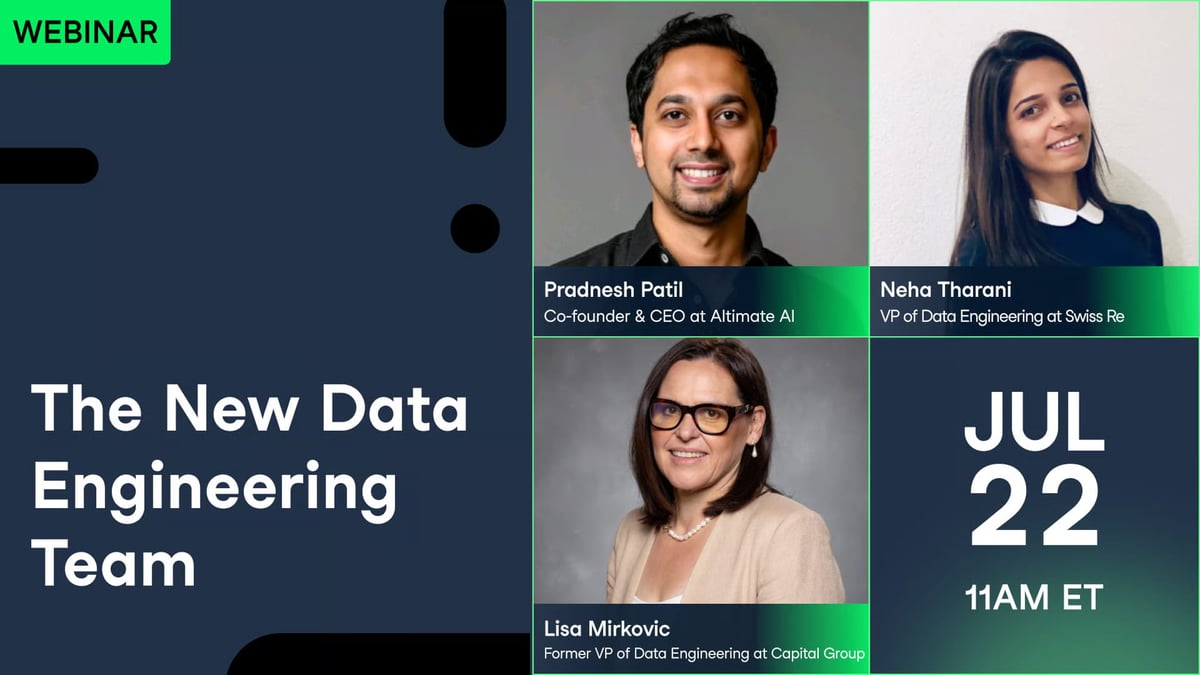
Now that job candidates write their resumes and rehearse their interview answers with AI, every application reads the same. "Now every resume is perfect," Pradnesh Patil said on DataCamp's "The New Data Engineering Team" panel, part of its Data Science and Engineering Week.
Patil, co-founder and CEO of Altimate AI, joined host Richie Cotton alongside Neha Tharani, data foundation lead at the reinsurer SCOR, and Lisa Mirkovic, a data and AI strategy adviser who previously ran data engineering at Capital Group. Generative AI changed how data engineers work, and it also broke the funnels companies use to hire them.
Hiring when the resume stopped carrying signal
Resumes are not the only signal AI degraded. Video interviews are straightforward to game with live prompting tools, which leaves conversation as a weak test of anything. Altimate AI rebuilt its process around work instead: exercises capped at sixty to ninety minutes, followed by a short discussion. Candidates are told the rules upfront, in Patil's words, "you can use as much AI as you want."
The exercise measures what someone builds with AI available, not whether they can work without it. Patil noted that startups across the San Francisco Bay Area are changing how they interview for the same reason. Skills assessments built around real tasks are displacing credential and resume screening.
Validate agent output with a data diff, not a second model
Large language models are probabilistic, so the validation layer around their output is the thing you actually build. Patil's example was SQL. When an agent rewrites or optimizes a query, the test is whether it returns the same data as the original: "is it producing the same data with a new query?" You do not need a second model to check that, only a data diff tool that compares the two result sets directly.
The pattern generalizes to anywhere an agent touches a pipeline, a transformation, or a query. Each of those places needs a lightweight deterministic check attached to it rather than an assumption of correctness.
AI documents move the cost to the reviewer
AI also created a collaboration cost that is easy to miss. A teammate generates a six-page document in five minutes, then expects a colleague to spend forty-five minutes reading it. Patil's rule is to edit AI output down before passing it on, because the models are built to overproduce. As he put it, "all these LLM models are text hungry. If you ask it to do something instead of writing five lines, it's going to write five pages."
Governance became a daily job
Governance is where the new risks concentrate, and Patil pointed to public incidents rather than hypotheticals: an agent that ran a query costing more than five thousand dollars, and production databases dropped at larger companies. "If you let it scale without guardrail, it's going to do crazy things," he said. A per-tool setting does not contain that, because an agent moves across tools and the guardrail has to move with it. Altimate AI open-sourced a rules-and-permissions framework, Altimate Core, under an MIT license as one starting point.
Where agents already pay off
Fenced in properly, agents produce measurable wins. Patil described a Fortune 500 company that built agents to manage its data infrastructure, resizing instances and adjusting configuration automatically as workloads shifted. Utilization climbed and the bill fell by 30 to 40 percent. The reason is bandwidth: "as humans, we can't change infrastructure configurations, thousand times a day, but a machine can."
For platform teams deciding where to deploy agentic automation first, infrastructure tuning is the low-risk, high-return place to start.
Getting knowledge out of people's heads
Mirkovic described where a team's working knowledge actually lives, "hidden in Wikis and Slack channels and in a senior developer who is there twenty seven years, and only that person knows quirks that are not even in a GitHub repo."
Patil sees teams democratizing that knowledge so business users self-serve the simple questions and bring back only the hardest 20 percent. That is the direction both agreed on: less work done by hand, more work made repeatable for AI and for everyone else.
Teams building 2026 roadmaps can use that split as the test for where agents belong in the stack and where human judgment still has to lead. If the governance layer is the gap, start from Altimate Core instead of writing your own rules engine.