Your Job Just Became QA for an AI Pipeline You Didn't Design
Sometime this year your job changed, and nobody sent the memo. You used to write code. Now you mostly approve it: you read a summary, it looks right, you hit accept, and you've moved on before you could have checked it even if you wanted to. The machine produces faster than any person can verify, and the distance between what it ships and what you actually confirmed grows every week.
So what does that make you? Not a tool's user. You are managing a labor force whose work you never read, and you are the only check between its confident output and what reaches production. You are the trust layer.
The defining problem of this era isn't that AI can't do the work. It's that it does the work far faster than anyone can check it.
I Instrumented My Own AI Usage Like a Data Pipeline
I know because I measured it. I wrote a small proxy, pointed it at my own machine, and logged every request that crossed the wire for forty-eight hours. One developer, two days: 11,302 requests across 109 concurrent sessions and sub-agents. The last change one of those agents handed me had taken it six minutes and something close to an afternoon of human work. I looked at it for eleven seconds, then hit accept. I read what surfaced and trusted the rest. So do you.
I Logged 11,302 AI Requests over two days. Only 37.5% Were Actually Correct.
Sub-Agents Are Unmonitored Nodes in Your Pipeline
The first problem with a trust layer made of one person is that it's uneven. How much gets caught depends entirely on who is holding the line. A senior catches a surprising amount by reflex: the function that's subtly wrong, the assumption that doesn't hold. A junior catches less, because spotting the bad answer is the same skill as writing the good one, and that skill is the thing they're still building. And the ten sub-agents your agent spawned that nobody opened? Those are checked by no one at all. Across a real team, the work is thin on checking, and thinnest exactly where no one is looking.
Why AI Generation Outpaces QA Capacity
The second problem is worse, because it doesn't care how good you are. Generation is parallel and nearly free: one prompt fans out into ten agents. Your attention is serial and fixed: you read one thing at a time, and there are only so many hours. So as the volume climbs, the fraction any human can actually check falls, and not gently. It heads for zero. The senior's reflexes don't beat this. They just start from a higher number on the way down.
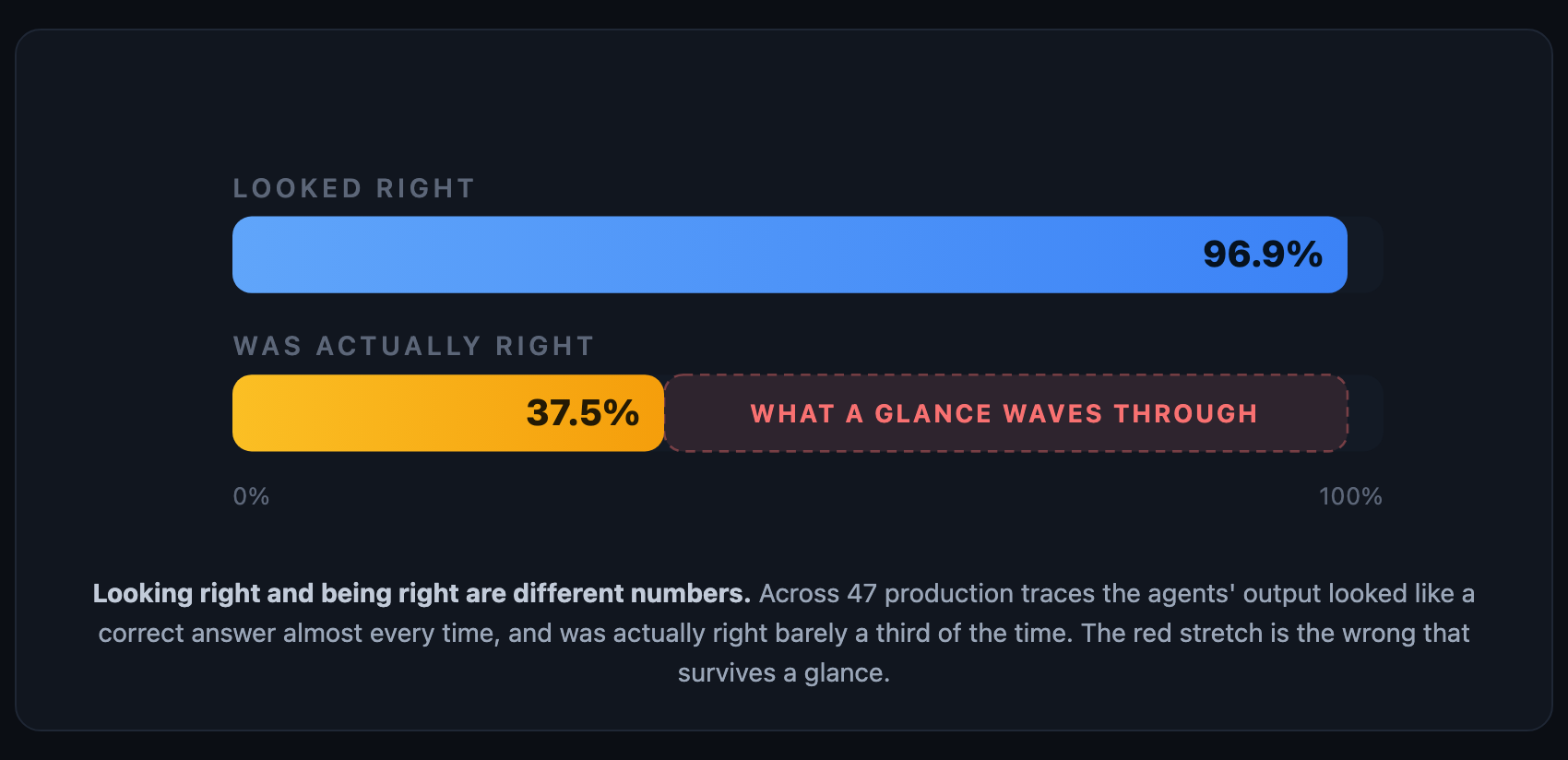
96.9% Looked Clean. Only 37.5% Passed Validation.
You might assume the part you don't check is mostly harmless, or you'd have noticed by now. I assumed that too, until I scored it. Almost everything the agents produced looked like a correct answer: clear, confident, well-formed. Barely a third of it actually was one, once I checked it against the code and the task in front of it. Looking right and being right turn out to be very different numbers, and the gap between them is exactly the part a quick skim waves through.
Bad Lineage Happens One Accepted Diff at a Time
And the work you don't check doesn't disappear. It ships, things get built on top of it, and (this is what turns a backlog into debt) the next agent reads it as context and repeats it as fact. A wrong assumption from Tuesday is settled truth by Friday, cited in code none of you wrote by hand. You took the debt on to move fast. It accrues interest quietly, and it comes due later: the incident, the rollback, the week spent tracing where the data went wrong.
The person clicking accept is almost never the person who pays.
Data Debt Doesn't Show Up on the Dashboard Until It's Expensive
That's why you, personally, feel fine. The cost is displaced. It lands in time, weeks after the commit that caused it, and it lands on other people: the junior who trusts the senior's pace without the senior's reflexes, the teammate who inherits the module, next quarter's version of you. It's also why the best engineer on the team is the most sure there's no problem. He's right about his own desk. He just isn't the one holding the bag.
One developer can absorb this by hand for a while, which is the whole reason it stays invisible. An organization can't. Multiply it across everyone shipping this way and there is no trust layer left, only thousands of accepts a day, a rising balance of unverified work, and no single place that can tell you which of it was real.
Today the trust layer is you: by reflex, in the seconds between accepting one diff and starting the next. That was never going to hold. The only open question left is whether you replace it on purpose, with verification that runs as fast as the work is produced, or keep paying the debt until it picks the moment to collect.
Numbers from a local proxy run against one machine over a 48-hour window: 11,302 requests, 109 concurrent sessions and sub-agents, and a 47-trace correctness sample in which 96.9% of output looked right and 37.5% was actually right. Measured, not modeled.